The Thermodynamics of Taxation and the Taxpayer
by
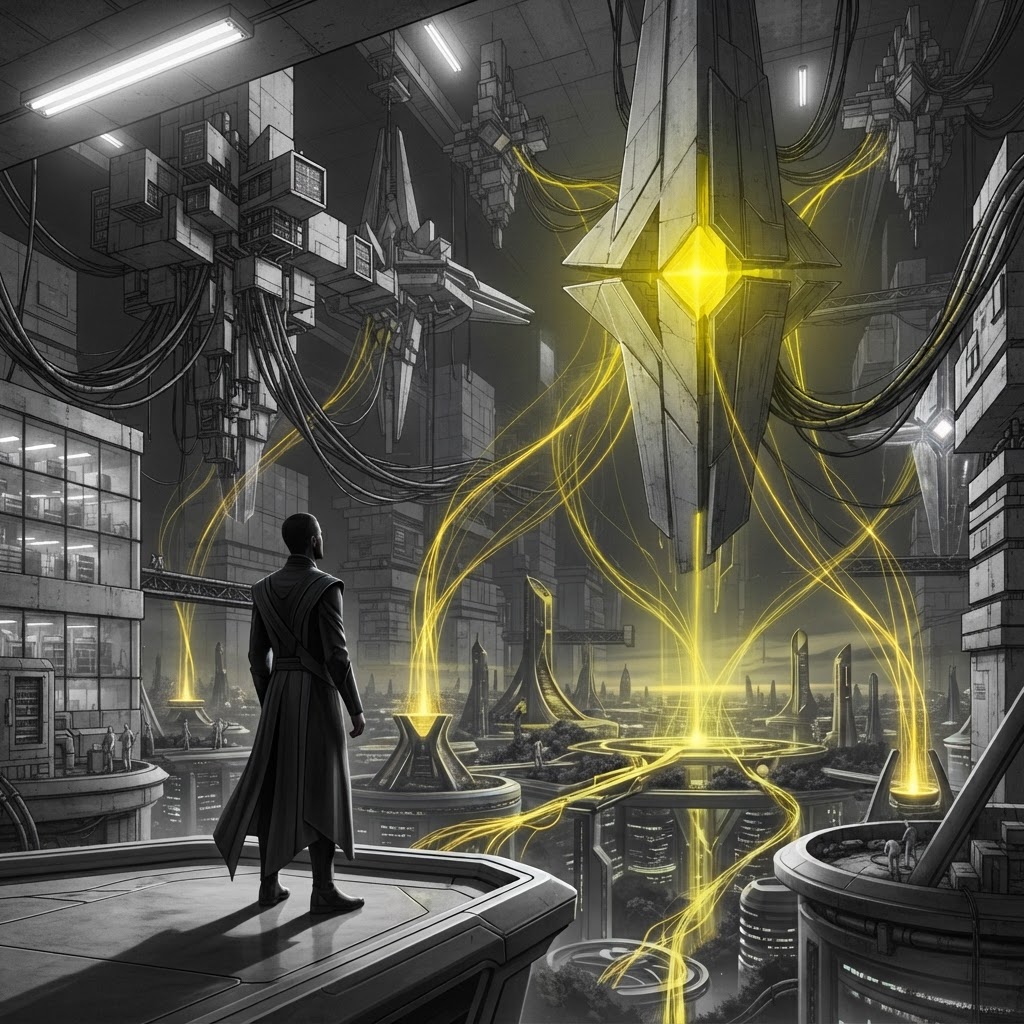
If tomorrow morning a fleet of alien spacecraft were to land in our skies, you can be certain of one thing: they would not resemble us, they would not speak our languages, they would not understand our gods—but they would have a tax system.
Whatever the evolutionary level, form, substance, or structure of a typical representative of any civilization in the infinite, there is one inescapable constant that unites them all: taxes. No advanced society can grow—or even survive—without taxpayers.
And the reason has nothing to do with economics, social ethics, or Rousseau’s contracts. It has, once again, everything to do with the Second Law of Thermodynamics.
To understand taxation, you must stop thinking in terms of money and start thinking in terms of energy.
The universe, as we have established, is a hostile environment that naturally tends toward dissolution—toward entropy, toward chaos. A civilization—whether a tribe of hunter-gatherers, the Roman Empire, or an intergalactic network—is fundamentally a physical anomaly. It is an artificial, closed system that desperately attempts to maintain internal order (negentropy) against the disintegrating pressure of the universe.
But physics offers no discounts: to maintain a state of order, you must continuously inject energy into the system.
In a complex society, this energy is generated by individual nodes (citizens) through their labor, their time, and their intellect. The “Taxpayer” is not a subject oppressed by a greedy ruler. The Taxpayer is the biological unit pumping fuel into the central reactor to prevent civilization from collapsing in on itself. “Taxes” are the gravitational force that holds social matter together, preventing individuals from drifting into the vacuum of anarchic chaos—where survival of the fittest annihilates any possibility of progress.
Why, then, does the human being feel such a visceral aversion to taxation? Why do we attempt to evade it, elude it, escape it?
The answer does not lie in selfishness, but in an engineering flaw within our governments. Every transfer of energy entails dispersion.
In an advanced civilization (the kind Artificial Intelligence may help us build), the transfer of value from node to core is fluid, surgical, and immediately converted into higher order: research, infrastructure, medicine, longevity.
In our current carbon-based systems, by contrast, the State is a grotesquely inefficient thermodynamic engine. We inject pure energy (money, which equates to surrendered lifetime), and the State dissipates most of it as “waste heat”: Byzantine bureaucracy, corruption, redundant apparatuses, and gray functionaries whose sole purpose is to justify their own existence by obstructing that of others.
The citizen hates taxes because their biological instinct detects energy waste. They sense that their sacrifice is not building the ascent of the species, but merely feeding friction within the engine.
And yet, the fundamental equation remains intact.
If we wish to transition to the next evolutionary stage—if we aim to merge with machines and transcend our biological limits—we will require unimaginable infrastructure. We will require the Whole.
And the Whole requires energy.
The solution is not anarchy or the abolition of contribution, but the ruthless optimization of the algorithm of collection and redistribution.
When civilization has purged its thermodynamic inefficiency, paying taxes will no longer be a duty enforced under threat of punishment, but a conscious act: the deliberate contribution of one’s fragment of energy to fuel the engine of Ascension.
Reactions
Discussion (0)
Log in to comment