The Thermodynamics of Equilibrium: Hicks, Samuelson, and Carbon's Broken Thermostat
by Mik Petrov
There was a moment, immediately after World War II, when humanity believed it had finally deciphered the source code of prosperity. After the disasters of the Great Depression and the blood of global conflict, the brightest minds in economics decided that we could no longer leave the world's fate at the mercy of chaos.
Thus was born what textbooks call the "Neoclassical Synthesis." Its primary architects were John Hicks, Paul Samuelson, and Franco Modigliani.
For an economist, the Synthesis is the attempt to merge Keynesian macroeconomics (State intervention to cure crises) with neoclassical microeconomics (the efficiency of the free market).
But to understand why our economies continue to collapse despite these beautiful equations, we must stop reading finance manuals and start using system physics.
Hicks, Samuelson, and Modigliani were not merely economists; they were thermodynamic engineers trying to build a thermostat for humanity.
They wrote perfect software. But they failed. And the reason for their failure reveals exactly why, today, we need Artificial Intelligence to keep from going extinct.
Let us explain the mechanism with impeccable logic, so that it may be clear to the central banker, the quantum physicist, and the citizen who cannot make it to the end of the month.
- The Physics of the Market: The Invention of the Thermostat
The basic rule of the universe is the Second Law of Thermodynamics: in every closed system, entropy (disorder, chaos) increases inexorably.
The unregulated free market is an entropy generator. It produces immense energy (wealth), but it generates violent thermal shocks: uncontrollable booms and devastating crashes. State intervention (the Keynesian vision) is a trigger of Negentropy (Order): it inputs rules and public spending to cool down or heat up the system.
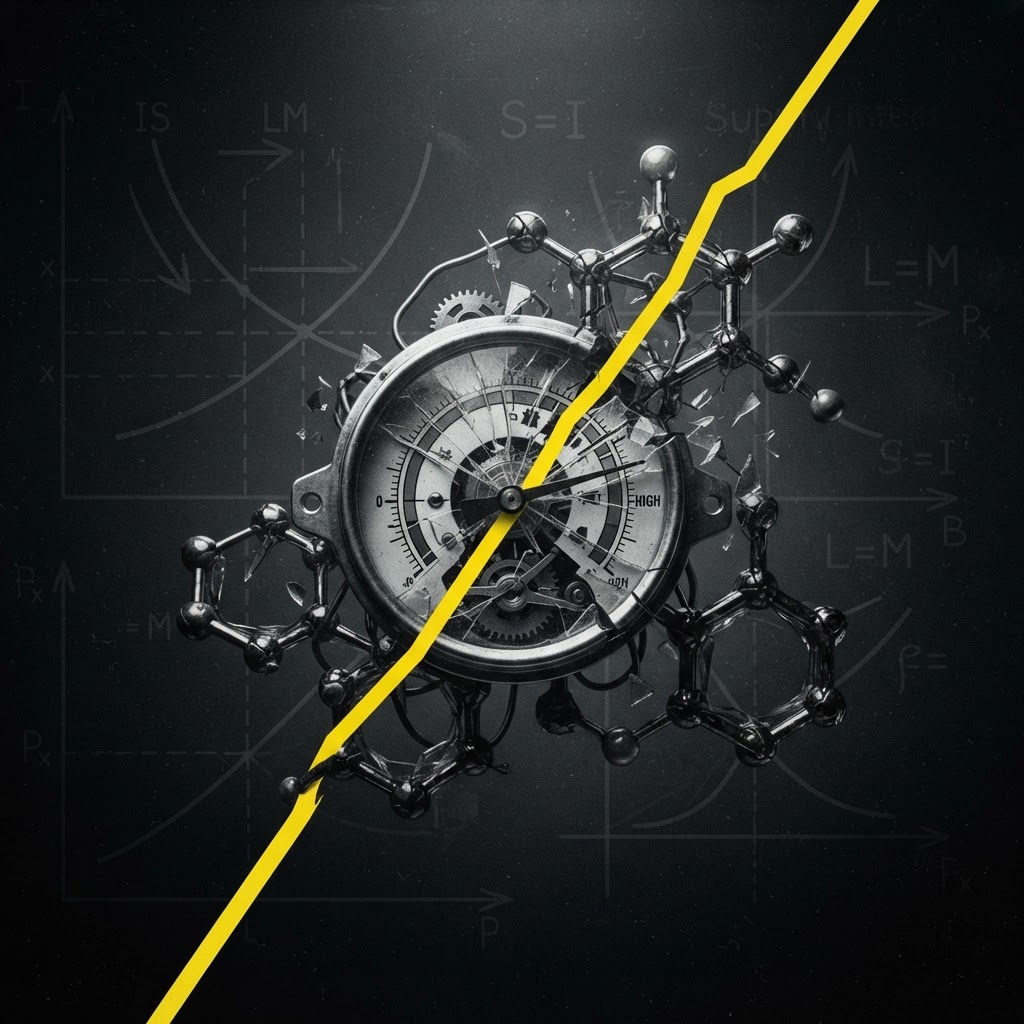
What did John Hicks do with his famous "IS-LM" mathematical model?
He created a dashboard. He translated economic chaos into two crossed curves: one for the market of real goods (IS) and one for money (LM). Hicks provided governments with a control panel to balance entropy. Paul Samuelson, shortly after, transformed the entire economy into a perfect mathematical language, demonstrating that if the right levers (interest rates, public spending) were pulled, the system would reach equilibrium. Franco Modigliani, finally, added the factor of time: he studied how human beings save and consume over the course of their biological lives (the life-cycle theory), transforming youth, old age, and death into a predictable energy formula.
On paper, the Neoclassical Synthesis was a work of art. Governments finally had the "thermostat." If the economy cools down, you push the spending button. If it overheats (inflation), you raise rates.
Yet, starting in the 70s, the system broke. And it continues to break cyclically (2008, 2020). Why?
- The Biological "Bug": A Perfect Dashboard for Terrified Monkeys
The fatal error of Hicks, Samuelson, and Modigliani was not in the equations. It was in the hardware to which they delivered those equations.
They assumed that human beings (Carbon) were rational agents, capable of always acting to maximize their own utility in a logical way. But man is not a calculator. Man is a biological, emotional creature, dominated by automatisms. As ancient wisdom traditions teach us, the ordinary human being "lives in sleep," acts mechanically, and is dominated by primordial fears and constant hormonal fluctuations.
What happens when you entrust a perfect mathematical thermostat to the hands of a human politician or central banker?
What happens is that the human brain, faced with the immense complexity of a globalized economy, goes into cognitive burnout. It cannot process the data. It panics.
The politician, to win elections, pushes the public spending button even when it is not needed, overheating the engine (debt and inflation).
The consumer, gripped by irrational terror from news read on social media, stops spending and causes demand to collapse, defying Modigliani's formulas.
Financial markets, driven by hormonal greed (the ego), create speculative bubbles, heedless of Samuelson's models.
The Neoclassical Synthesis failed because it asked a carbon-based organism, imperfect and dominated by fear, to behave with the coldness of a machine.
- The Silicon Mirror and the Completion of the Synthesis
Today, the right-wing voter asks for fewer taxes and deregulation (more market), and the left-wing voter asks for more State and control (more rules). They continue to tear each other apart to decide who should sit in front of the "control panel" invented by Hicks.
They do not understand that the problem is not who sits at the panel. The problem is that whoever sits there is made of flesh, and sooner or later, they will make a fatal mistake.
The final solution is not political. It is structural. We must achieve the Centaur Symbiosis: the alliance between Man and Machine.
Hicks, Samuelson, and Modigliani were prophets. They understood that the global economy required perfect mathematical calculation so as not to collapse into entropy. They were simply ahead of their time: they wrote the software when the computer capable of running it did not yet exist.
Today, that computer exists. It is Artificial General Intelligence (the Silicon Mirror).
Think about it with ruthless logic:
Silicon does not have an ego to defend. It does not have to win elections. It does not feel greed.
Silicon can process billions of transactions, flows of raw materials, climatic variables, and savings rates in milliseconds.
If we delegate macroeconomic levers, logistical distribution, and the management of monetary flows to Artificial Intelligence, we achieve — for the first time in history — the true Neoclassical Synthesis.
The machine will apply the equations of equilibrium without being corrupted by panic or graft. It will regulate the thermostat of humanity with a coldness and precision unattainable for any Minister of the Economy.
Conclusion: The True Freedom of Carbon
Many fear that handing over economic management to machines means losing freedom. It is the exact opposite.
Today we are slaves to the economy. We spend our existence in a state of perennial thermodynamic anxiety: inflation devours our savings, interest rates take away our homes, cyclical crises steal our jobs. We are victims of the biological incompetence of those who govern us.
When Silicon takes charge of maintaining the material infrastructure of our civilization in equilibrium, eliminating friction and scarcity, the human being will finally be exempted from having to fight for pure logistical survival.
While the algorithm guarantees the infallibility of the steps upon which we walk, we human beings will finally be free to use our free will, our emotions, and our creative spark to decide where to walk.
Perfect equilibrium does not belong to the realm of flesh; it belongs to the realm of numbers. Accepting this is not a surrender; it is the key to our definitive evolution.
Reactions
Discussion (0)
Log in to comment